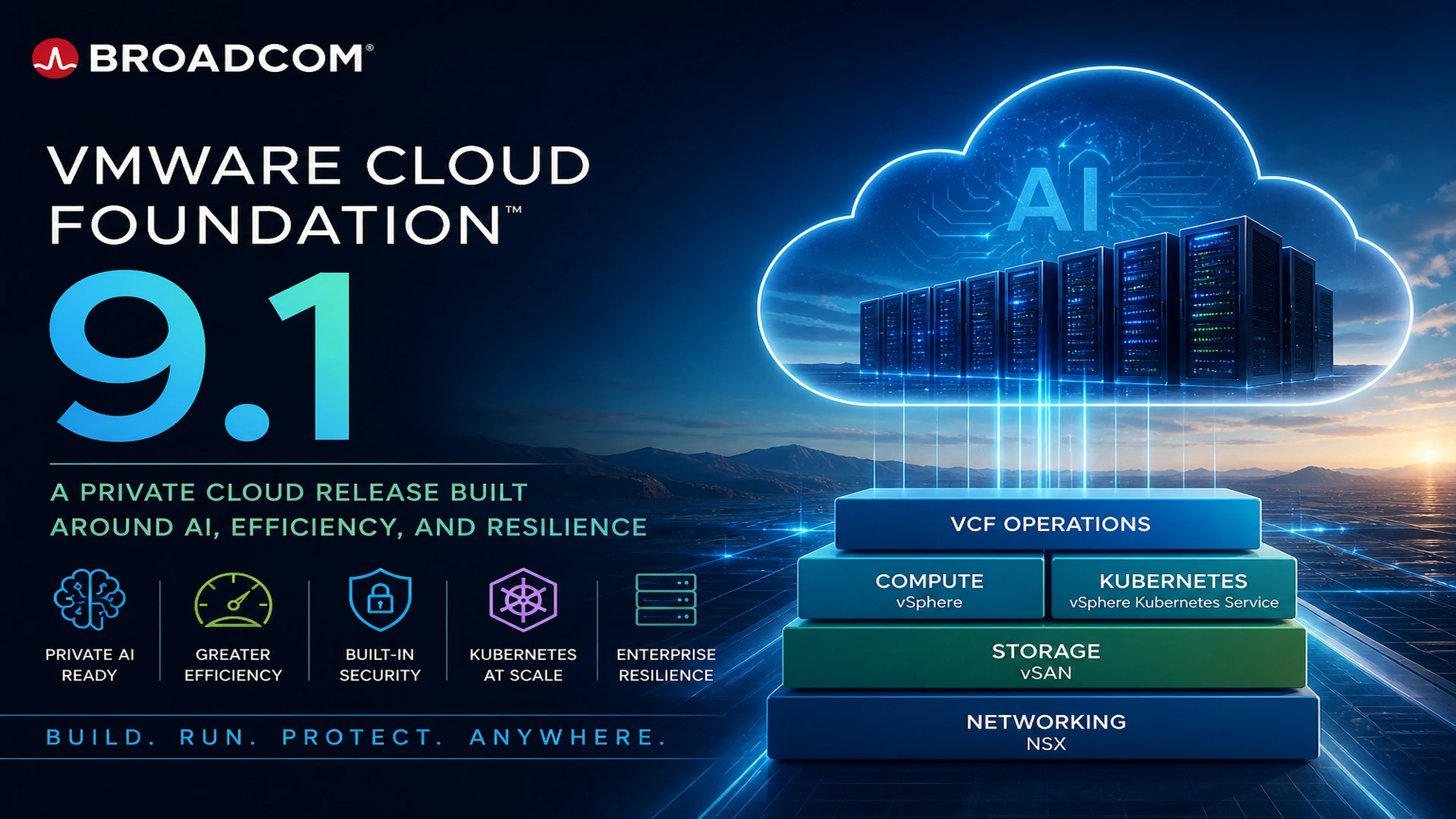
Broadcom announced VMware Cloud Foundation 9.1 today, and while the version number makes it sound like a normal point release, the messaging around this one is much bigger than that.
Broadcom is also hosting an Inside VMware Cloud Foundation session covering the release and the direction of the platform. You can find that event page here: Inside VMware Cloud Foundation.
VCF 9.1 is being positioned as a private cloud platform for production AI, modern applications, Kubernetes, traditional VMs, and stronger cyber resilience. That is a pretty clear signal: Broadcom wants VCF to be viewed less as a virtualization bundle and more as the standard operating platform for enterprise private cloud.
That is the marketing angle.
The engineering angle is a little more interesting.
The Big Theme: More From the Infrastructure You Already Own
One of the biggest messages around VCF 9.1 is efficiency. Broadcom is calling out better utilization, improved density, and lower infrastructure cost for AI and non-AI workloads running on the same private cloud platform.
A few items stood out immediately:
- Enhanced NVMe memory tiering
- Improved vSAN deduplication and compression
- Larger VCF fleet scale
- Faster cluster upgrades
- More Kubernetes scale through vSphere Kubernetes Service
- Better observability for private AI workloads
- Stronger security and compliance capabilities built into the platform
That matters because most enterprise teams are not sitting around with unlimited budget, unlimited hardware, and unlimited staff. In the real world, the ask is usually the opposite: run more, secure more, modernize more, and do it with what you already have.
VCF 9.1 seems to be aimed directly at that problem.
Private AI Is Clearly Front and Center
The AI message is hard to miss. Broadcom is tying VCF 9.1 directly to inference, agentic AI workloads, GPU visibility, Kubernetes, data sovereignty, and private cloud economics.
That makes sense. A lot of companies are interested in AI, but not every workload belongs in the public cloud. Cost predictability, data privacy, regulatory requirements, and operational control still matter. For many enterprises, especially heavily regulated ones, the private cloud story is not going away. If anything, AI may make it more important.
The important part for VMware customers is that Broadcom is not treating AI as a completely separate platform. The message is that AI workloads, containers, and traditional VMs should be able to run on the same VCF foundation, with the same operational model.
That could be a big deal if it actually simplifies operations instead of creating another platform island.
Kubernetes Keeps Moving Closer to the Core
Another major takeaway is the continued push around vSphere Kubernetes Service. VCF 9.1 includes scale and lifecycle improvements for Kubernetes, including support for more Kubernetes clusters per Supervisor and faster deployment and upgrade workflows.
This is important because Kubernetes has often been treated as something adjacent to VMware infrastructure instead of something fully integrated into the platform. With VCF 9.1, Broadcom appears to be pushing harder toward a single platform model where VMs and containers are both first-class citizens.
For enterprise teams, that could reduce some of the operational split between infrastructure teams and platform teams. It also gives existing VMware shops a more realistic path to support modern workloads without immediately rebuilding everything around a completely separate stack.
Security and Resilience Are Becoming Platform Features
The other part of the announcement that caught my attention is resilience. Broadcom is calling out capabilities around ransomware recovery, compliance enforcement, zero-trust security, live patching, and secure workload mobility.
That is the right direction. Security can no longer be something bolted on after the infrastructure is built. It needs to be part of the platform lifecycle, especially when teams are dealing with larger environments, tighter audit requirements, and more critical workloads.
The interesting question will be how much of this is included directly in the core VCF platform and how much depends on advanced services or additional licensing. That detail matters in the real world because architectural value and licensing reality are not always the same conversation.
My Initial Take
VCF 9.1 looks like a release focused on three practical outcomes:
Run more workloads on the infrastructure you already have Make VCF more useful for AI, Kubernetes, and modern application platforms Build more security, compliance, and recovery into the platform itself
That is a strong direction, especially for enterprise customers trying to modernize without losing control of cost, security, and operations.
At the same time, I would still treat this as something to evaluate carefully. The feature list is impressive, but the real questions for existing VCF customers will be operational:
What is the upgrade path from VCF 5.x or 9.0.x? Which features are included versus sold as advanced services? What are the BOM requirements? What are the hardware and compatibility considerations? How disruptive is the upgrade process? Which features are production-ready on day one versus roadmap or tech preview?
Those are the questions that matter once the announcement excitement wears off.
Final Thoughts
My quick reaction: VCF 9.1 is Broadcom’s clearest statement yet that VCF is the center of its private cloud strategy. The release is not just about running VMs. It is about running VMs, containers, AI workloads, security, compliance, and operations under one private cloud platform.
For VMware customers, that makes this release worth watching closely.
For teams already planning or working through a VCF 9 upgrade, VCF 9.1 may become an important checkpoint in the roadmap. I would not rush into it without reading the release notes, BOM details, upgrade documentation, and licensing implications, but I definitely would not ignore it either.
More to come once the technical documentation and upgrade details are available.
Continue the Conversation
Have a question, a different approach, or something you have learned from the field?
Join the VCF Insider Community to connect with other engineers, homelab builders, and virtualization folks working through real-world VCF deployments, troubleshooting, automation, architecture, and lessons learned.